
How Tamara Larisa Tyrbouslu of eXp Realty Stops Culture From Killing International Real Estate Deals


Cultural differences can make or break an international real estate deal. A lowball opener, a missed decision-maker, or the wrong eye contact can sink a closing that price alone would have saved. The fix is preparation. Learn how your client negotiates, then brief the other side.
On this episode of Square Feet and Side Quests, I sat down with Tamara Larisa Tyrbouslu of eXp Realty on International Real Estate, a CIPS broker-salesperson, NAR faculty member, and my former instructor, to talk about international real estate done the human way.
Curious how one storm-out in a conference room turned into a lifelong friendship? Here's a preview of our conversation:
Why Cultural Fluency Decides Who Closes International Deals
Culture shapes how people negotiate, who makes the final call, and how trust gets built.
Miss those signals and a good deal falls apart over nothing. Tamara said it plainly during our talk. Plenty of transactions blow up only because two sides see the same offer through different cultural lenses, and the agent in the middle isn't patient enough to work through it.
Watch the full episode here:
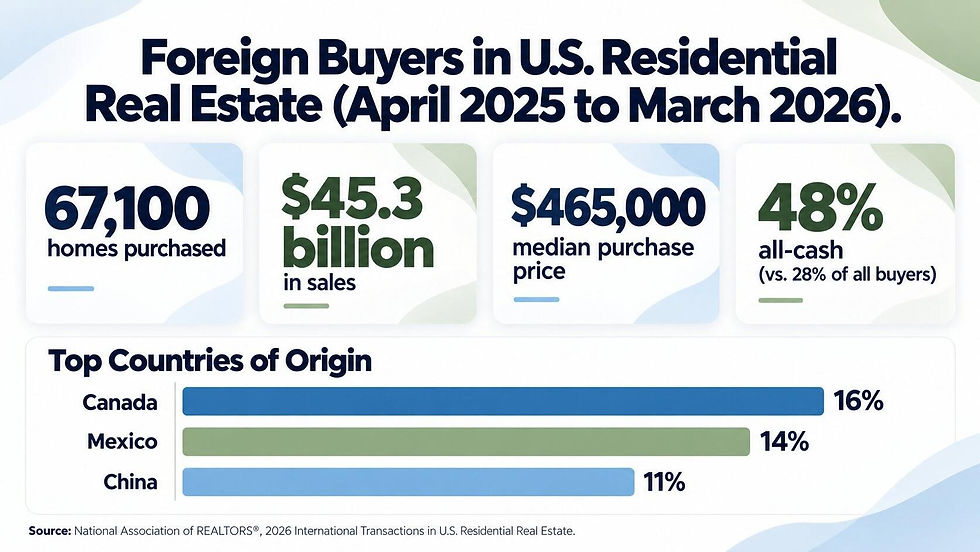
This matters more than most agents realize. NAR's 2026 report on international transactions in U.S. residential real estate found foreign buyers purchased 67,100 existing homes worth $45.3 billion between April 2025 and March 2026. Nearly half of them paid all cash. Canada, Mexico, and China led the list of buyer origins. Every one of those buyers brings their own expectations to the table.
That's why I wanted Tamara on the show. She leads a global real estate practice in Las Vegas and has trained thousands of agents as National Association of REALTORS® faculty. She also served as a NAR ambassador to Guatemala. And she taught my Certified International Property Specialist (CIPS) course. NAR's CIPS designation program includes five full days of study on the critical parts of international transactions. Tamara doesn't just teach it. She lives it.
Her journey started with frustration when she bought her first home in her twenties and hated the process. She got licensed for investment property and realized she could change real estate. Before selling a home, she took international courses. The designation required three cross-border deals, a hundred points, and five courses, but she began despite the time commitment.
That kind of story is exactly why I launched this podcast. I wanted to explore the human side of real estate, not just the square footage. Tamara shares more of her teaching and global real estate insights on LinkedIn, and she's well worth following.
Ask About Goals Before You Ask About the Listing
Tamara calls herself a conscious realtor. To her, that means relationship-based business instead of transactional deals. It means asking yourself, "How am I showing up in this moment?" It also means remembering that every decision you make touches someone else's life.
In practice, it starts with one question. She asks every seller, every buyer, and every agent who wants to work with her the same thing. What are your short-term and long-term goals?
The answer can change everything. A seller might invite her for a listing presentation, expecting to list. Then the goals emerge, revealing selling isn't their best option, and Tamara tells them. Buyers receive the same honesty.
So do agents considering a move to her brokerage team. Some people get into this business and learn it isn't for them. If real estate is just a bridge to something bigger, she'll gladly help them cross it faster.
She told me it matters to her that everybody lives their heart's desire, and that we can all do it at the same time. That's a trusted advisor talking. Not a salesperson.
Her own rough first purchase is a reminder of how lost buyers feel without real guidance. It's why I keep returning to education for first-time homebuyers on this show.
The same truth holds on the commercial side. Whether I'm helping a mom-and-pop shop or a regional company with a board behind it, I'm still dealing with people. My energy can lift a client up or drain them. That's the standard I hold at my Las Vegas commercial real estate advisory firm, and Tamara's approach sharpened it.
Prepare the Other Side Before the Lowball Offer Lands
This was the answer I needed most. I asked Tamara how she represents two clients from two different cultures without letting that gap kill the deal. Her answer had two parts. First, understand each culture, especially how people negotiate and make decisions. Second, educate the other side before the offer arrives.
"There are some cultures who just love to negotiate, and they are going to start low, low, low. And other cultures just don't. They're like, how much is it? You have those two different parties on opposite sides, and you could have something blow up that didn't even need to happen. So I prepare the seller: just so you know, this offer is much lower than you're anticipating. My client loves to negotiate and this is just a starting point. We are expecting a counter, and please do not be offended by this offer, because it's just their culture. And if there's an agent on the other side, I tell them, by the way, my client is going to negotiate right up until the end. They may ask for something the day of closing, so just be prepared."
Tamara Larisa Tyrbouslu
That is cross-cultural real estate negotiation in its simplest form. You don't change anyone's style. You change what the other side expects. Researchers have studied this same tension for years. Erin Meyer's widely read Harvard Business Review piece on how to negotiate across cultures shows how differently cultures handle disagreement, emotion, and trust at the table. Tamara's playbook is the field version of that research.

I once represented an Asian client seeking industrial space, facing a $1.25 per square foot quote while they wanted to offer 95 cents. Concerned about honesty from the other side, I panicked, as such a gap can waste brokers' time. Understanding the cultural context helped me prepare the other side, leading to a successful placement in flex space with office and warehouse. Deals like that are a big reason why choosing the right commercial space is never only about the building.
I once worked with a German tour company leasing space for Route 66 motorcycle tours. Initially, I wasn’t meeting their efficiency expectations until I asked for feedback. They clarified their needs, and I adjusted accordingly.
Both deals made me glad I took Tamara's class. I share more lessons like these from the leasing side through my commercial real estate insights on LinkedIn.
Recovering From a Cultural Misstep Without Losing the Client
When I asked Tamara what international work taught her about client service, she replied: Authenticity. Cultures are too diverse to master, and individuals are unique. Mistakes will happen. Being present lets you notice shifts and take responsibility.
Her story about three Egyptian buyers illustrates this. Referred by a Peruvian client, they wanted to buy three properties in cash on their last day in town. Tamara usually researches cultures beforehand, but there was no time.
She spoke English with the couple and French with the sister. While discussing the sister's offer, Tamara addressed her directly. Suddenly, the brother-in-law stormed out.
Tamara followed a man who preferred to make decisions. She apologized, explaining that her culture respects addressing women. She told him to smoke his pipe while she waited.
He returned calmer, and after a few encounters, he gifted her a hookah from Cairo, leading to a lasting friendship.
Years ago, as a concierge at the Wynn, I had a similar moment. A Middle Eastern guest's wife had every room in her name, so I addressed her. Her husband became agitated. I knew little about cultures then but started splitting my eye contact evenly between them.
Here's the lesson for anyone working with international real estate clients. People forgive mistakes when they can tell you're genuine and truly care. A sincere "Is there something I did?" saves more relationships than any perfect script.

How Travel and Belonging Make You Better With Global Clients
Tamara's work centers on belonging. She believes everyone desires it—some feel it instantly, others never do. Her multicultural upbringing made her sensitive to this. Her simple view: we all belong, and it begins within. Be good with yourself, and you'll belong anywhere.
Travel teaches quickly. Tamara described places like Ireland and Madeira, where her family roots are deep. Greece, Puerto Rico, Peru, and Egypt are next on her list.
For me, it's Morocco. In Marrakesh, a shisha lounge owner I met had his family bake me a birthday cake. We spoke in three languages using Google Translate. Another night, two brothers invited me over, and their mother cooked couscous and lemon chicken, refusing any payment. I learned gratitude is shown with flowers or drinks, not cash. I share moments like these from my international travel adventures on Instagram.
Lessons from client work emphasize the importance of relationships and a slower pace in business. Agents who recognize this earn trust faster. Effective communication, aided by language skills, is crucial; for example, Tamara's French helped with an Egyptian client. Both Tamara and I use AI translation tools to simplify cross-language conversations.
Holding Calm When a Transaction Goes Sideways
Tamara practiced Feng Shui before she ever got licensed. Most people know it as the ancient Chinese art of placement, the idea that your environment shapes your success. Her version starts with the body and mind, which she calls the first environment we live in. She cultivates her own energy every day so all of her shows up for clients.
"Buying and selling real estate can be very stressful for people, and it's important that I am the calm in the storm. Regardless of what's going on, if things are going sideways, I am holding a space of calm and security that everything is ultimately going to work out for everybody's highest and best good. And it does. Even if the deal is lost, it was for people's best good. Hindsight's 20/20. They won't realize it until later. We have clients who are going through hardships, maybe a divorce or their company is going bankrupt. As long as we're there to hold this space and be a positive resource for them, that's ultimately how I blend it into my real estate."
Tamara Larisa Tyrbouslu
That is Feng Shui in real estate at its most practical. Before it ever touches a floor plan, it shapes the agent. A client facing a divorce or a failing business borrows your energy. If you panic, they panic.
For clients who want more, Tamara applies Feng Shui directly. She prepares charts that guide which direction a home should face. After closing, she helps orient the space inside.
Sellers weighing a move can start with a home valuation in Las Vegas and layer that guidance on top. She never pushes it. Some clients want it and some don't, and that's fine with her. She balances active and passive energy, the yin and yang most people recognize, to fit how a space will be used. Her Feng Shui and mindful living posts on Instagram show that grounded approach in action.
Reframing Deal Obstacles With One Better Question
Near the end, I shared something a Buddhist friend always tells me. If the universe keeps putting obstacles in your way, maybe you're forcing something that wasn't meant to happen. I often catch myself asking, "Why is this so difficult?" Tamara offered me a better question.
"The question that you are asking is, ' Why is this so difficult? And questions are so important because they actually move things forward. They move a conversation forward, they move life forward, they help us focus. So I encourage a different question, which is: what if this is the best thing that could have ever happened? Sometimes those obstacles that show up are just there to show us something. Hey, look at this: this is what's in the way of you getting there, and you have to address this first. So you deal with that obstacle and befriend it. Instead of something being against you or being difficult, you ask, " How does this become a cooperating variable?"
Tamara Larisa Tyrbouslu
That one landed hard. I used to read friction as a sign to push harder. Now I treat it as a signal. When a lease negotiation drags, or a client goes quiet, I ask what the obstacle is showing me. Sometimes it's a cultural gap I haven't bridged yet. Sometimes the space simply isn't right for the business. In retail and industrial tenant representation, saying so early saves everyone time and money.
There's science behind this, too. A 2012 study in the Journal of Experimental Psychology:
General found that people taught to reappraise stress as helpful showed healthier cardiovascular responses and paid less attention to negative information. Tamara's question works the same way. It changes what you see, so it changes what you do next.
She teaches this mindset alongside the technical work. Agents can find her post-licensing, continuing education, and upcoming CIPS Institute classes through her international real estate courses and continuing education. For more stories from the deal table, follow my Las Vegas commercial real estate updates on Facebook.
Want to hear my entire conversation with Tamara Larisa Tyrbouslu of eXp Realty on International Real Estate, about how cultural fluency saves international real estate deals before price ever becomes the problem? Listen to our podcast episode.
International Real Estate Questions Agents Ask Most
How can real estate agents avoid cultural misunderstandings with international clients?
Start by learning how your client communicates, negotiates, and makes decisions. Then prepare the other side so different behavior isn't read as disrespect. When a misstep happens anyway, own it quickly. Tamara shares everyday lessons like these on her Las Vegas global real estate Facebook page.
How should agents handle a very low opening offer from an international buyer?
Set expectations before the offer goes out. Tell the seller or listing agent that your client negotiates as a cultural norm. Explain that the opener is a starting point and a counter is expected. Flag the chance of last-minute requests so closing day doesn't come as a shock.
What does it mean to be a conscious realtor?
For Tamara, it means relationship-based business instead of chasing transactions. You stay present, act with intention, and ask about short-term and long-term goals before recommending any move. Buyers and sellers can explore her real estate resources for buyers and sellers to see that approach in practice.
Is the CIPS designation useful for commercial real estate agents?
Yes. I come from commercial leasing, and the CIPS training changed how I handled an Asian industrial client's opening offer and a German company's communication style. Culture shows up in leases and letters of intent just as much as in home purchases.
How many foreign buyers purchase homes in the United States?
According to NAR's 2026 report, foreign buyers bought 67,100 existing U.S. homes worth $45.3 billion between April 2025 and March 2026. Forty-eight percent paid all cash, compared with 28% of all buyers. Florida, California, and Texas drew the most international buyers.
Apply to Be a Guest on the Square Feet and Side Quests Podcast
Real estate keeps crossing borders. Buyers arrive from new places, leases get signed across languages, and the people who thrive are the ones willing to learn from every side quest along the way.
If you're a commercial broker, an international investor, a CIPS member, or someone building a business and a bigger life at the same time, I'd love to hear your story on the show.

Comments